

3 countries, 2 years, 1 global perspective; everything you need to know about this new joint master’s scholarship.
If you’re looking for a fully funded master’s that combines environmental engineering with real international experience, a new programme just entered the field: EESIC — Engineering for Environmental Sustainability and International Cooperation.
It’s a brand-new Erasmus Mundus Joint Master’s (EMJM), and if you’re the kind of applicant who wants technical depth and a genuinely international academic path rather than staying at one university for two years, this is worth knowing about early, especially since the first intake hasn’t opened yet.
What EESIC Actually Is
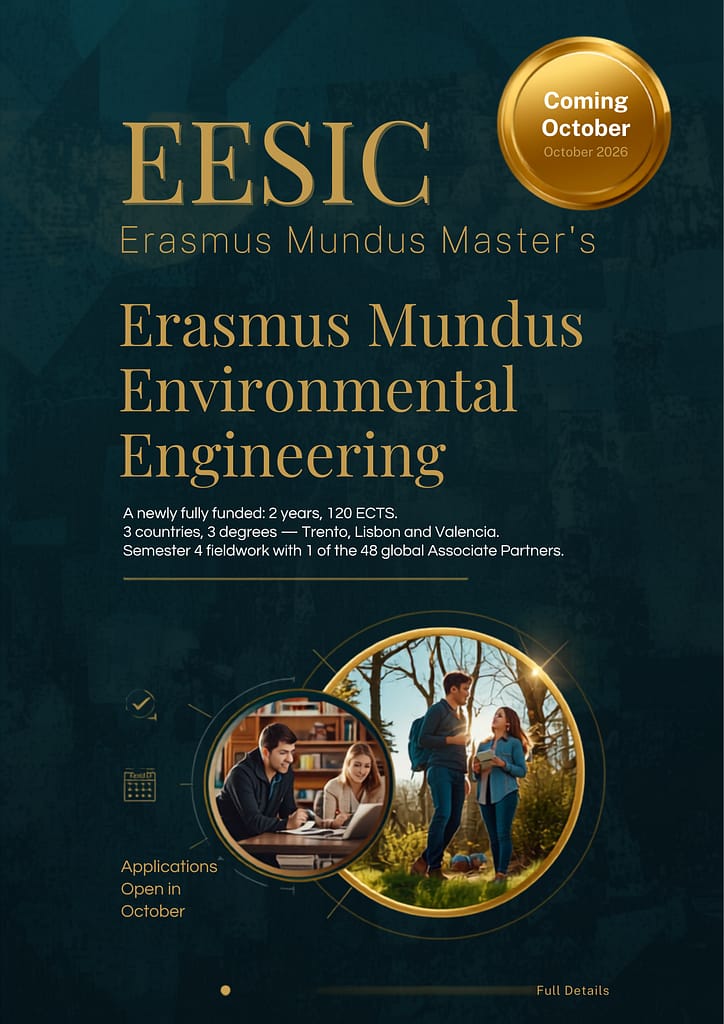
EESIC is a two-year, 120 ECTS MSc programme jointly managed by three universities:
- University of Trento (Italy) — coordinating institution
- Instituto Superior Técnico, Universidade de Lisboa (Portugal)
- Universitat Politècnica de València (Spain)
The programme is built around a simple idea: environmental engineering can’t be taught, or practiced, from inside a single country’s context anymore. So instead of specializing narrowly, EESIC trains a new kind of graduate, someone with a strong engineering foundation plus the interdisciplinary and intercultural skills to manage complex, global sustainability problems.
How the Two Years Are Structured
This is the part that makes EESIC stand out from a typical master’s programme:
- Semester 1 one of the three partner universities
- Semester 2 a second partner university
- Semester 3 the third partner university
- Semester 4 fieldwork and thesis, carried out with one of 48 Associate Partners worldwide
So by the time you finish, you’ll have studied in Lisbon, Valencia, and Trento, and completed hands-on fieldwork with an international partner organization — not just a classroom capstone project.
The teaching approach itself is described as interdisciplinary, challenge-based, and hands-on, which lines up with where environmental engineering education is generally heading: less theory in isolation, more real-world, cross-border problem-solving.
What You Graduate With
Because EESIC is a joint programme across three countries, graduates don’t receive one generic joint degree — they earn three separate degrees in environmental engineering, one from each of the three universities (Portugal, Spain, and Italy). That’s a meaningful difference if you’re thinking about where you want to work afterward, since you’ll hold recognized qualifications from multiple EU countries rather than one.
Applications for the 2027–2029 Intake
Here’s the timing to keep in mind: applications for the 2027–2029 cohort open in October 2026.
Since this is a new programme, there isn’t yet a long track record of past application cycles to study the way there is for older Erasmus Mundus programmes — which can work in your favor if you’re comfortable being an early applicant to a fresh, well-backed initiative. Coordinated by an established institution like the University of Trento and built on formal Erasmus Mundus Joint Master’s funding, it’s not a small or untested project, just a new one.
For full programme details, curriculum breakdowns, and the application portal itself once it opens, the official EESIC website is your best source: eesic.eu
If you’re planning to apply, this is the moment to start preparing rather than waiting for the portal to open:
- Review the Erasmus Mundus Joint Masters programme structure so you understand how funding and mobility work across EMJM programmes generally
- Look into the individual departments at University of Trento, Instituto Superior Técnico, and Universitat Politècnica de València to get a sense of the research strengths you’ll be drawing on across the three semesters
- Start thinking now about your motivation letter, with a programme this new, admissions committees will be paying close attention to why you specifically want the international, cross-border structure, not just the environmental engineering content
Is EESIC Right for You?
This programme will suit you especially well if:
- You want an engineering degree that carries genuine international weight, not just a single-country credential
- You’re drawn to sustainability and environmental engineering specifically in the context of international cooperation, not purely technical research
- You’re comfortable relocating multiple times across a two-year period — this isn’t a stay-in-one-city programme
- You want fieldwork experience with a real-world partner organization, not just a thesis written from a library
If that sounds like your profile, keep October 2026 marked, and start your preparation now rather than after the call opens.
Curious about how to prepare documents for Erasmus Mundus funding? [Read this → How to write CV, Cover letter, Sop and references. ]